Music and Mind: Renee Fleming presents new music medical breakthroughs.
Nashville Symphony Presentation on ‘Neuroarts’ with Renee Fleming
Renee Fleming
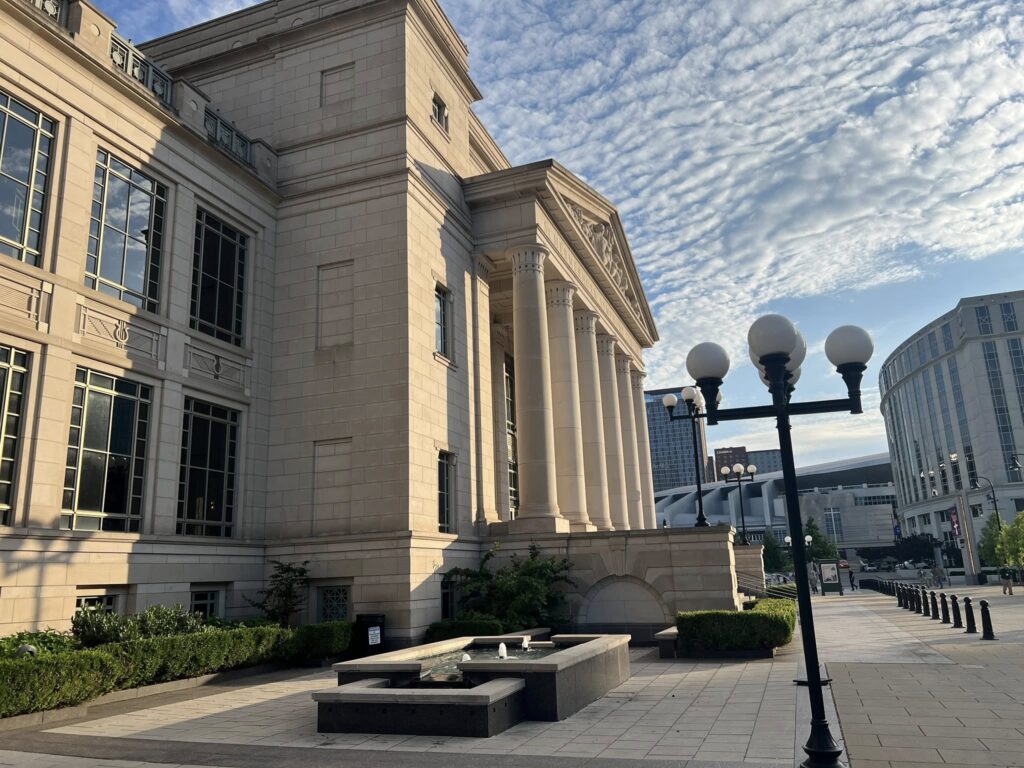
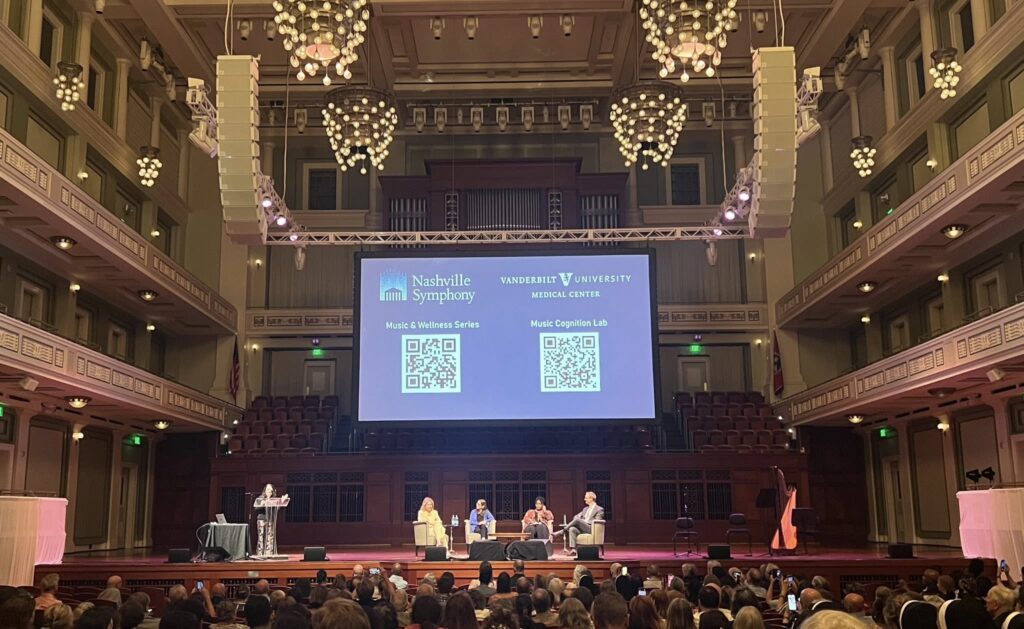
World renowned operatic soprano Renee Fleming teamed up with a group of therapists, doctors, and musicians in a presentation about a new area of medicine called “Neuroarts” at the Schermerhorn Symphony Center on Monday, May 18, 2026 at 7:00 p.m. It is part of the Nashville Symphony and Vanderbilt Medical Center’s focus on mental health and mindfulness.
- Renee Fleming, as speaker.
- The Nashville Symphony
- Rachel Miller, Harp (Vanderbilt Blair School of Music)
- Anthony Parce, Viola
- Vanderbilt Music Cognitive Lab (https://www.vumc.org/music-cognition-lab/welcome)
- Kelly Corcoran, Sociology
- Miriam Lense, PhD: Otolaryngology
- Dr. Andrew Woolridge, MD: Palliative Care (https://medicine.vumc.org/department-directory/Andrew-Wooldridge)
- Kyshona Armstrong, Music Therapy
- Song writing as Journaling: Group Song Writing
Getting There
The drive down to Nashville was about as good as it gets. Slowly but surely they are coming along with the expansion of I-65 but that didn’t help the Northbound folks much coming out of Nashville. My recommendation is to take Exit 90A and get on 31E to get to downtown, called the Ellington Parkway. However, on game days at the football stadium all bets are off. This bypasses the confluence of I-65/24/40 and the helter skelter of those interchanges. The gold standard of parking is at 222 2nd Street. When you purchase through the Symphony’s Parkwhiz link it saves you some I think. You want to enter by way of 2nd, but exit the parkhouse on the 1st side, take a right, then left at the light on the bridge over the river, connecting you to I-24 West and that sweeps you out of the city, as if you are on a fast flowing river. The great thing about this is that you are right at the river’s edge and can take a walk to do a Siddharthian moment of contemplation as the currents of the Cumberland River flow past you.
The “Event”
The evening began with a brief Harp and Violin intro that reminds one of the meditative music associated with India, Hinduism, and Buddhism. The beauty of the music with just those two instruments in that vast, glorious hall is next to impossible to describe. Following this intro, the audience was led through several meditative ‘exercises’ by the violinist and accompanied by the harpist playing the famous aria “The Song to the Moon” from Antonin Dvorak’s opera “Rusalka”. The result was a sort of ‘palette cleaning’ for the mind so that the audience could receive the information that was going to be shared.
It is difficult to not associate Renee Fleming with this aria, which she seems to have sung thousands of times. She acknowledged with appreciation the playing of the piece in her introductory statements.
My Life in the Neoroarts
In writing these reviews I am experiencing a ‘mental load’ issue because there is so much to know and although I know a lot, I am finding that synthesizing it into coherent writing is a real challenge, especially at a speed that I wished I could produce. I am also involved with ‘other’ things that increase the problem and on top of all of that the management of life in general gives one enough to do.
However, last night’s presentation showed me how lucky I am to be able to have so many things running through my mind. It means I am neurologically healthy, at least for now. I have been processing life through the arts since I first started in music about 50 years ago. Much of my mental health, such as it is, was also due to my childhood environment provided by my loving and caring parents and the people that surrounded my family. Both of my parents played the piano, sang, and were admirers of the arts while not being professionals at them. The churches we attended were full of music as well. So, I was always surrounded by the arts and never really appreciated just what a gift that was for my formative years.
This presentation also showed me that the book I wrote “Boredom to Brilliance” is on the right track. Where the presentation emphasized the value of “Neuroarts” on patients with various mental and physical health issues was the focus, my book focuses on the importance of “Neuroarts” on mentally and physically healthy people who don’t realize that doing artistic pursuits are existential to a high quality of life no matter the level of art you may achieve. It is in the doing that it is beneficial, even if it is just attentively listening, looking, tasting, smelling, and feeling the world around them. Nature is our primary teacher and it is the point of departure for a mentally and physically healthy life.
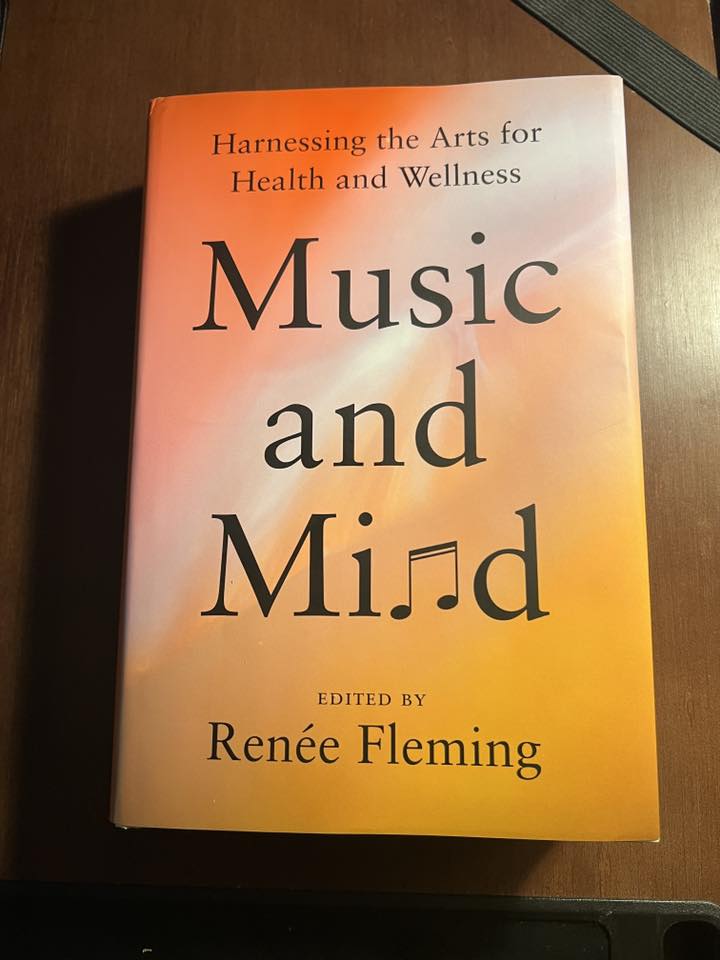
Music and Mind: Harnessing the Arts for Health and Wellness | edited by Renee Fleming
I have not yet flipped through the circ 500 page book that Ms. Fleming put together “Mind and Music”. I purchased it and she was kind enough to sign copies for those after the lecture. I’m not one to ask for autographs at all, but this seemed to be a good opportunity to meet her, even if only briefly. It was a complete pleasure to meet her and I am looking forward to her concert on Wednesday with Rodney Gilfry, Baritone and the Nashville Symphony.
Neuroarts: A ‘new’ branch of the medical field.
90 minutes was a short time to jam the starting points of various areas of work being done in the area of “Neuroarts”. My definition of Neuroarts would be: “The science of music and other arts in treating mental and physical illnesses.” In the first couple of paragraphs of the book, Ms. Fleming writes that using the arts was considered “Soft science”. Today, this has shifted to a concerted effort to explore this ‘new’ area of medicine.
It is literally mind blowing what this research is revealing and the therapies create amazing results. Stuff like, people who have difficulty walking can dance, people who have difficulty speaking can sing, and people who are under stress can focus on doing something in the arts to alleviate that stress. The arts give us something to do. It is an activity based therapy which develops skill and control over patients minds and bodies.
My father, Dr. Robert E. Simpson wrote his Master’s thesis using the emotional reactions to music as a tool to diagnose psychological issues in healthy adults. My book Boredom to Brilliance is about using the artistic method to find your way in life and in the arts. I was thrilled about all of these elements flowing together into one area of study that is well worth doing.
The bottom line about all of this is that the arts aren’t a luxury but are as essential to the wellbeing of a human as water, oxygen, nutrition, and exercise. The power of this can be multiplied when plugged into the areas of social involvement and community. I am aware of different programs in the Bowling Green area where the arts are used to help challenged people. These are great things that people are doing. Certainly SKYPAC and the Public Theater of Kentucky are engaged in such activities. I’ll admit I don’t know a lot about these things here, but I will look into it more in the future.
Take Aways
There are so many aspects of this area that to go into them would take a while. I want to make you aware of some of the topics discussed that were touched on by the members of the panel. This list is in no particular order:
- Stage Fright
- Changing your goal to make your art a mission and not a test.
- Public Speaking
- Neuro-Resonance or Brainwave therapy using sound waves
- Reminiscence Memory Bumps
- The music you learned in your youth
- The music your parents learned in their youth
- The music your grandparents learned in their youth.
- Create your own playlist
- Write down or record somehow a playlist of the music that you loved growing up so that if your mind starts to fade as you age, this music can be played to reconnect your memory.
- Song Writing as Journaling
- Self “Talk Therapy”
- The “Third Mind” created through writing songs with others.
- Rhythmic Diagnostics
- Identifying brain disorders through rhythms played by patients.
Captioning for the Hard of Hearing
One thing that was brought up during the Q and A period was the topic of ‘captioning’. It is something I hadn’t thought of before in this way. An audience member was saying that it would have helped him to have “Captions” or as we say in the opera “Surtitles” (Sur means above, Sub means below: so Above the Stage) to help deaf people understand what is being said. In opera they use surtitles to translate the opera being sung on stage into the language that the audience speaks. In Germany they use Surtitles even for German operas like Der Rosenkavalier or Lohengrin etc, because at best it is difficult to understand the language being used, even if you are fluent. What this reminds me of is that surtitles can make going to the theater for deaf people also a thing to be able to participate in.
The Inspiration to Live
My personal motivation to go into music was out of a visceral desire to impact others to ‘feel something’ of high value. To me, music was a transfer of energy from me to the audience through the direct signaling of sound waves created by my voice to the listener’s ears. I always felt like it was my heart singing and I wanted to share my heart with others so they can know how much I care. Impacting people from the stage is what a performing artist does. But, now those things no longer seem lofty but rather essential for a happy life. Not everyone is a performer, I get that. But, everyone has a beating heart surging with feelings and those must be handled. Knowing now that this amazing world of “Neuroarts” exists gives me new inspiration to keep pushing on for the cause of great music performed live.
Musiterania is about manifesting the promise of music, and all arts, to create a sort of “Paradise” in cities and towns everywhere. Musiterania is like an explorer mapping the landscape of Classical music all across the country. The idea is to ‘Discover’ America in a way that has never been done before and to notice the incredible work being done. I feel it is very important to get people to the concert halls to hear untampered music created by great musicians all over the country. Why? Because it is what makes us human.
P.S. No AI editing used here. To get the thing done it is as written. This is a huge topic and well worth looking into. Pardon any mistakes I made.
Profoundly important, Tim, and very much appreciate and welcome news to me. I adore Renee Fleming for so many reasons already; this is yet another! Thanks to you and Musiteranea…
Thanks so much for your kind comments! It is a fascinating subject.