
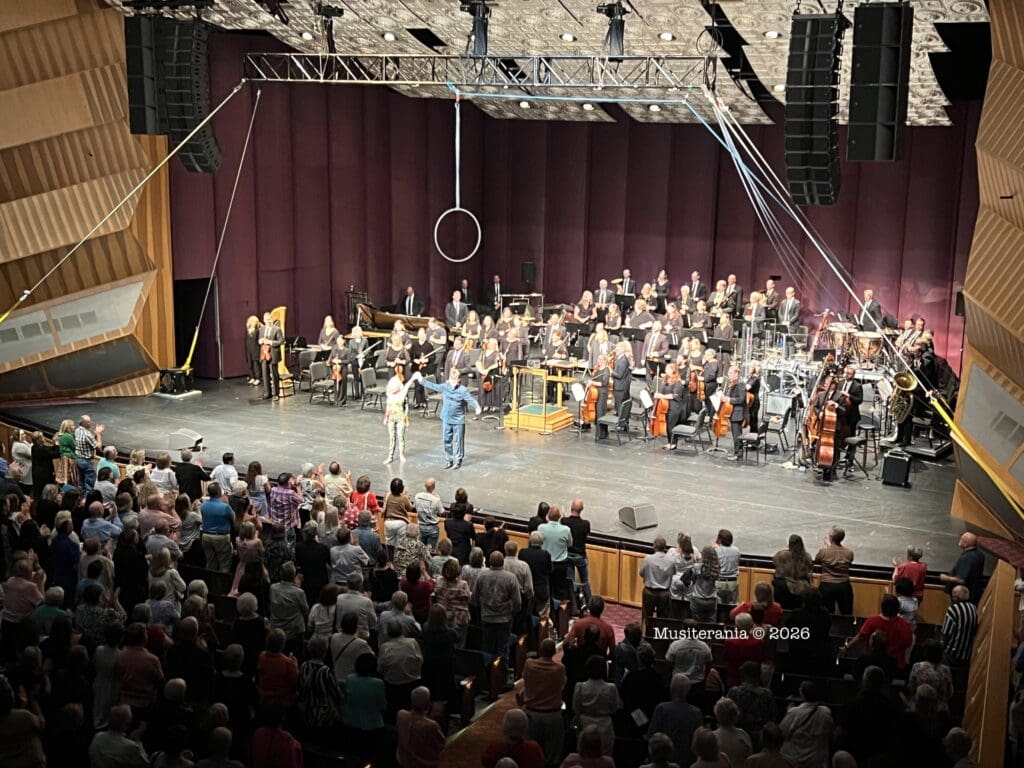
Over the Moon: Orchestra Kentucky’s Collaboration with Multifaceted Artist Janice Miller and the Debut of the New Music Director Joseph Trafton.
Claude Debussy's "Clair de Lune" was inspired by the Impressionist Poet Paul Verlaine's poem. That is what an evening of music and performance is: an "Impression".
Your soul is a chosen landscape
On which masks and Bergamasques cast enchantment as they go...
A "bergamasque" is a rustic dance associated with Bergamo, Italy. The "chosen landscape" is our soul, a musical canvas upon which masks and dances create a sense of wonder. Such an evening doesn't call for a specific description, but rather an impressionistic one.
"I believe in strength."
This is the answer Janice Martin gave to a question I asked following her outstanding performance. How are you able to maintain the flexibility in your hands and fingers to play the violin and piano after using them to climb and hang from ropes, fabrics, bars, and the Moon?
Janice Martin is a strong woman; that much is clear. But she has the type of strength that doesn't limit her body's ability to perform finely tuned actions. The last thing I expected to hear about was Bruce Lee and how, through her martial arts training, she learned to use her body fluidly. The aerial acrobatics alone would be enough for anyone to master; to play difficult classical music well, upside down and backwards on a violin, is quite another thing. Her soprano singing is very nice, and she possesses a wide range. Her "Defying Gravity" from the musical Wicked was well chosen, both for its theme and for her vocal abilities. Having the pianistic skill to pull off "The Flight of the Bumblebee" at the end of the concert rounded out the evening in an exciting way. Her interaction with people is kind, poised, and focused. It is worth noting that she has an interesting book available on her website entitled "How I Learned to Fly," which has a lot to do with conquering fear.
Having an acrobatic violinist, vocalist, and pianist is sensational enough for one evening. The evening was elevated beyond the pedestrian concert experience by new Music Director Joseph Trafton and Orchestra Kentucky's enthusiastic willingness to perform music as varied as it was difficult. Orchestra Kentucky's Founder and Music Director Jeff Reed's gracious passing of the baton to Mr. Trafton is one of the most impressive things I have experienced in the world of music. Luckily, it has been passed on to a brilliant and experienced conductor whose Southern Kentucky roots automatically give him the street cred that echoes the sentiment that this is 'our' orchestra.
As Maestro Reed did during his tenure, Maestro Trafton took over with great enthusiasm and effectiveness. Being the Master of Ceremonies during the concert you are conducting, after all of the rehearsals and the heat of performance, is no small ask. He read poetry, explained the music we were about to hear, and what to listen for, all while being engaging, entertaining, and personable.
Most importantly to me, though, is "How do they play?"
One could assume that for a first concert you might play it safe and not 'attack' the music with the same aggressiveness one would gain over time. That didn't seem to bother Mr. Trafton in the least, and the orchestra responded well to the challenge. From the outset, the flashy Bernstein "Candide" overture blasted off with the requisite energy it takes to start a concert. The whirlwind tempi gave the audience an exciting musical introduction that didn't let up till the end of the concert.
The Medley of selections from Zigeunerweisen (Pablo De Sarasate), Irish Reel, and Pirates of the Caribbean introduced the audience to Ms. Martin's virtuosic violin skills. The piece builds to a fever pitch, as a medley should, which sparked appreciative applause.
Before taking flight, Ms. Martin presented "Defying Gravity" from Wicked and impressed with a well-rounded voice, demonstrating the ability to defy gravity vocally.
Changing into a striking, shimmering silver costume, Ms. Martin took to the sky during the gorgeous music of Antonio Vivaldi's Concerto "Winter" from his famous "Four Seasons". Playing the first movement from this piece is definitely not the easy way out for the soloist or the orchestra. The literal gravity-defying moment is when she plays the violin upside down, hanging from her knees, and arranging all of her movements without missing an entrance or note of musicality. I enjoyed the orchestra's performance as much as hers, as they answered every request to vary the dynamics and articulation of a very detailed piece. Playing profound music in this type of performance is something to be respected.
"Mothership" by the American composer Mason Bates would be pretty much the exact opposite of the Vivaldi. It seems that there is a lot of Bates being performed these days, as I have heard performances of his work in Louisville and Nashville. His vast orchestrations create many interesting moments for the listener, even if you aren't quite sure what you are hearing. Ms. Martin had a brief solo in this piece, along with other members of the orchestra, with flashy Trombone and tenor saxophone solos. It is a lot to listen to on a first hearing, but a lot of fun.
The first half ended with "A Stairway to Heaven" by Led Zeppelin. It is basically the piece arranged for orchestra, with Ms. Martin's violin 'singing' the vocal parts from "the Heavens". The arrangement makes for a hauntingly enchanting experience that builds slowly, gathers steam, and ends quietly.
The Orchestra presented an inspiring performance of the "Flying Theme" from E.T. the Extra-Terrestrial, by John Williams. What I love about Williams' film scores is that they translate so well to the concert stage for a full classical orchestral sound. Here, Maestro Trafton and Orchestra Kentucky delivered an impressive performance that the audience praised. Sometimes, Williams' music can be presented well by simply "beating through it." But this is not going to happen with Mr. Trafton. He creates moving musical moments by helping the orchestra shape phrases and guides the momentum with exuberance without losing control.
Continuing with the theme of flight, it is quite natural to include the topic of Peter Pan. "When Your Feet Don't Touch the Ground" from 'Finding Neverland ' (Gary Barlow) was a charming way to set up the remaining portion of the program. Without her feet touching the ground, danced in the sky like the mythological Pan while playing the violin and tumbling around in the clouds.
The next two selections, Aaron Copland's "Hoedown" from his ballet 'Rodeo,' get everyone's feet tapping again, while the "Orange Blossom Special" (Ervin T. Rouse) displayed Ms. Martin's 'fiddling' abilities to the max. She immediately captured the crowd with her cute jeans outfit made for this type of music. It was a lot of fun to hear and see, and the audience loved it.
Clair de lune by Claude Debussy is possibly the most beautiful piece of music ever written. There are so many different versions of it; you hardly know which one is the original. Dancing in the "Trapeze Moon" above the stage, Ms. Martin joined Orchestra Kentucky in a beautiful collaboration of soundscapes. The beautiful thing about live, pure, orchestral music is the clarity of sound. No noise, just the pure sound of the strings and the rest of the orchestra blending in a way that you hear everything individually.
Closing the evening with the 4th Movement from Nikolai Rimsky-Korsakov's Scheherazade was both courageous and thrilling. Ms. Martin tumbling around in the air, with the orchestra sounds swelling underneath her, was inspiring. It is a tour de force for all and thrilling for the audience.
For a nightcap, Ms. Martin played the piano in "Flight of the Bumblebee", also by Rimsky-Korsakov, with the orchestra, bringing the house down with all of the joy this evening offered.
Facet
What can one say about music or a performance? I am a rather severe critic at heart. However, the thing that I am the toughest on is the spirit of a performance. I've heard many 'perfect' performances that were as dull as a brick. While accuracy and perfection are the gateways to excellence, it isn't the goal of a performance. The goal is to move us in our beings and to lift us from the insane world that rages at our humanity.
While passion isn't the only thing that a performance requires, without it, there is nothing, no reason to listen. The thing is, this passion must be felt by the listener, and sometimes the musician can be 'over-passionate' and take away from the moment. It is a fine line, and it is one I am very sensitive to. The emotions have to be sincere and not feigned. They have to be fully committed without being obnoxious. There is no recipe for this; it is an intuition. It is cooking by feel, and we all sense when the taste is right.
Tonight, the taste was right.
As a performer, I remember thinking you could sense the audience's reaction during a performance. This is misleading. You really have no idea what is going on in the minds or hearts of an audience. All you can do is give your best.
The SKYPAC Theater is pretty large. The audience is somewhat far away, and the reaction can be slow and tempered. But it doesn't mean they are passive. For a concert like this, there is a lot to take in, a lot to process. Everything comes at you at the speed of light, and exits even faster. Everyone is trying to capture the moment, and the moment slips away like water through your fingers.
That is what makes it so special. The instant realization that all things are temporary, but can move our souls in a way that, without the experience, leaves us poorer inside. If we don't go to the concert, we may never know what we missed. But having gone, we are certainly glad we didn't miss it, because we are richer inside.
Musiterania Closing
There are evenings when music is something we hear, and there are evenings when music becomes something we experience. This was the latter.
Janice Martin flew above the stage, Orchestra Kentucky played beneath her, and Joseph Trafton began a new era from the podium. Yet the lasting impression isn't only the spectacle of someone playing a violin upside down or soaring through the air. It is the spirit behind it—the willingness to take risks, to trust strength, and to make something beautiful in a moment that can never be repeated the same way. Maybe it gives us the courage to trust ourselves a little bit more.
Perhaps that is what Verlaine's "chosen landscape" really means. For a few hours, music, movement, poetry, light, and imagination painted themselves across the landscape of our souls.
Then the lights came up.
The moment was gone.
The impression remains.