Since the beginning of electronic amplification, reproduction, and broadcasting of music, we have been slowly desensitized to the natural sounds of voices and instruments. Our ability to rewind, tweak, and otherwise manipulate sounds electronically has perverted the human ear to the point where we stop really listening altogether.
Just like the visual media has desensitized our eyesight, which blinds us to reality, the constant drone of junky ‘Muzak’ clouds our listening to the point of ignoring sounds altogether. We can’t see the trees for the forest. We can’t hear the birds for the flock. It becomes just all one cacophony.
I have a cousin who said to me once, “All music is noise.” I had to admit to her that she wasn’t wrong. I said, “Music is supposed to be music, and not noise, but today most people just make a lot of noise, and that includes the classical world as well.” The time constraints placed on all musicians to produce something quickly make it difficult to produce something well.
Having lived in Germany for half of my life in the world of classical music, I was able to experience a lot of ‘real’ music from the performer’s perspective. I was also able to hear a lot of real music from great halls. But it wasn’t until I was starved for it that I began to truly appreciate the delicate qualities of live music performance.
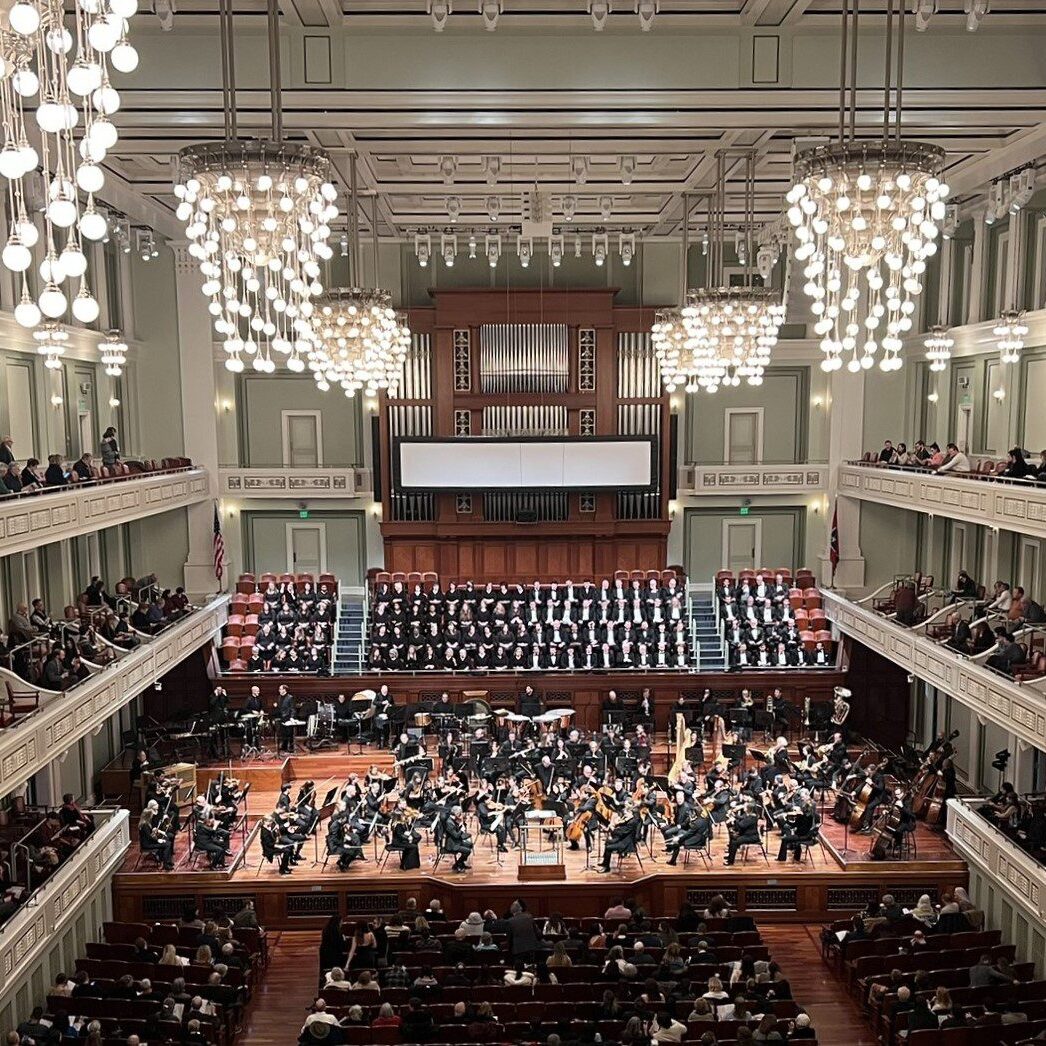
Sometimes you don’t fully appreciate something until it is lost. When I moved back to Bowling Green, Kentucky, to help my aging parents, I was able to hear live symphonic music on occasion. But going to the Nashville Symphony in the Schermerhorn Symphony Center has completely transformed my understanding and appreciation for this rare form of art. I am so grateful for that, but at the same time, I am faced with the reality that most people won’t ever reach the place where I am, so they can fully enjoy the benefit of listening to real music in real space and in real time.
I was never a fan of Gustav Mahler’s music. Why? Because I listened to recordings of it. I don’t care how good your stereo equipment is, Mahler just can’t be appreciated fully from a recording or broadcast. Mahler’s music is great, really only in the concert hall.
I have heard quite a bit of music with the Nashville Symphony. Beethoven’s 9th, Verdi Requiem, Daphnis and Chloe, The Rite of Spring, and much of the standard literature as well. I find sitting in the Balcony to be the best place to listen from, and also usually there are some seats that are open around me, which adds to my comfort. I have developed the ability to really listen carefully during a performance and enjoy the separation of the sounds as they are created. I recall a recent “New World Symphony” performance, which I know very well, and was so moved by the care and attention to detail that was performed in that historic piece. I have heard it many times on recordings, but live in Nashville was sublime. It is how music is supposed to be played and performed.
When going to a symphonic concert, or an opera, you can’t, nor shouldn’t, expect to be ‘wowed’, ‘blown away or in awe. It isn’t that immediate. The great composers somehow know how to create the effect of deep emotions welling up from the inside. It doesn’t blast you in the face. It grows from within. The immediacy and temporary nature of it make it like trying to hold a snowflake in your hand. It is there one second and melted away the next. It is so fragile yet so profound. You’ve been touched, but can no longer identify who or what touched you. It is gone. You can’t take it home with you.
One reason I am doing these previews and reviews is that I want to champion the live performance. I want to help people understand what it is they are going for and how to enjoy it. I believe it is a very important thing for society to cultivate because we all need to sit down, shut up, and just listen to something real for a while. I want this art form and its musicians to work into the future, and I would love to grow the demand for this kind of music.
This kind of music isn’t meant for massive venues and be amplified over huge distances. I get the financial attraction for the organizations, but it doesn’t really represent them that well. The true nature of this music is limited to halls of 2,000 or fewer. Eastman Theater has 3,500 seats in Rochester, and you need a large force to make that room work. So, the ratio from the cost of production to the paying ticket holder isn’t very high. This is why donations or other forms of massive support are necessary. But, it is worth it.
This weekend I plan on hearing Mahler’s 4th Symphony with the Cincinnati Symphony. We had to analyze the first movement in music theory class when I was in school. I am looking forward to hearing this glorious piece live for the first time.
Hope to see you there! Go!