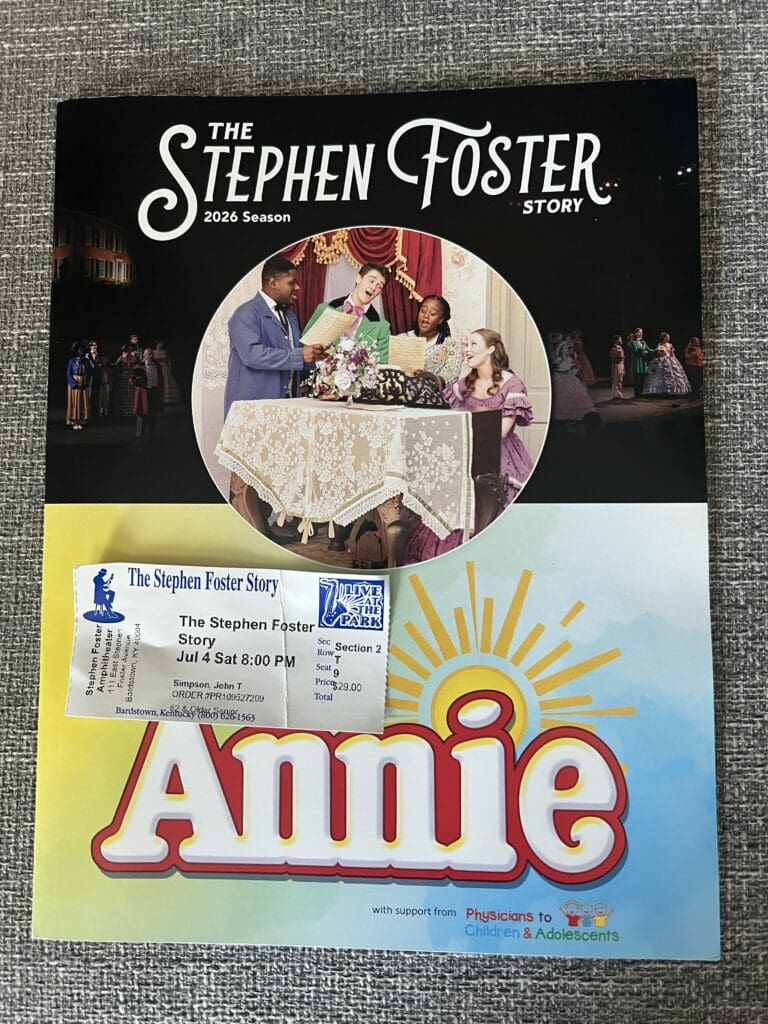
July 4th at the Stephen Foster Story: Stephen Foster’s 200th Birthday and the United States 250th Birthday Celebration Performance
The topic is beauty, truth, and love. What could be more universal to the human condition than those things? Add to that the mix of my personal journey, life experiences, and the reflections and associations that came flooding in when I arrived here today.
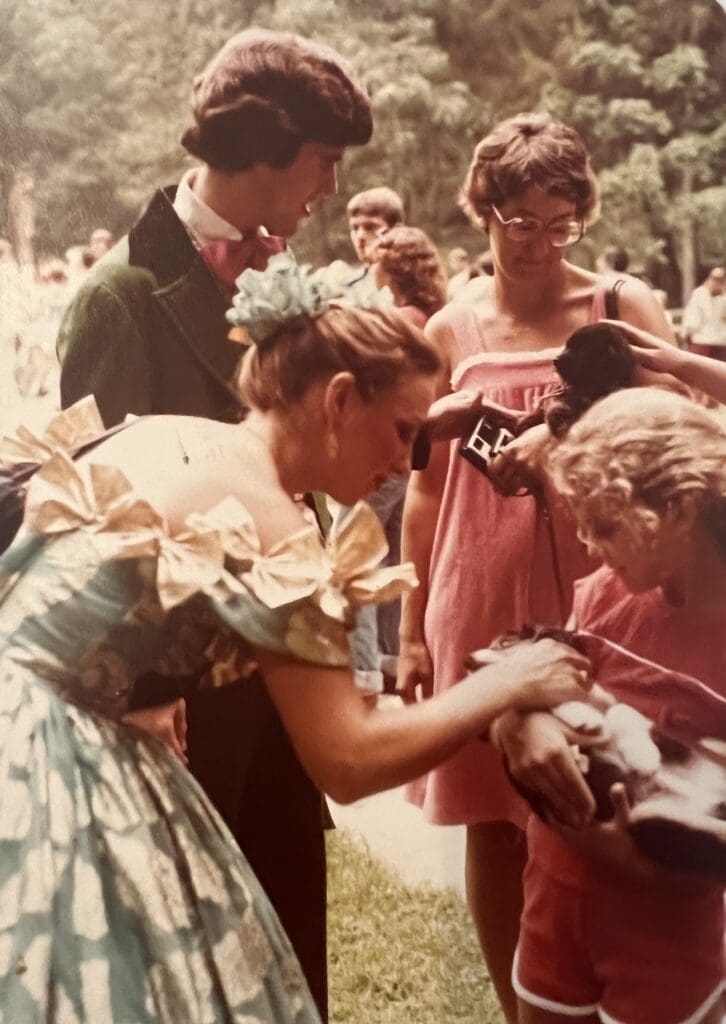
Stephen Foster was born on July 4, 1826. The Declaration of Independence was signed on July 4, 1776. I was a member of the cast of the Stephen Foster Story 45 years ago, during the 1981 season. I turned 21 in Bardstown, Kentucky, and was one of three of my colleagues to have a birthday on June 19th that year.
In my recent review of "The Hunchback of Notre Dame," I looked at it through the theatrical lens of being either a comedy or a tragedy. I coined it a tragedy, and in many ways one could categorize The Stephen Foster Story the same way. As much as the musical theater genre tries to put a happy face on rather sad topics, the fact cannot be avoided that the beautiful soul of Stephen Foster was only 34 years old in 1864 when he passed, broke, and thinking he was a failure. However, we have his songs, his music, his words, and the spirit that resonates even today with our modern-day cynicism and reminds us that we are made of more beauty and hope than despair and tawdry reality. The real value in any theatrical piece is the hope that everyone can do great things and show the love of human kindness amidst adversity. So, the happy ending of the legacy is that Stephen Foster lived and strived to bring beauty into the world with his brilliant melodic gift and thoughtful lyrics in the majority of his songs.
The role of Stephen Foster in this musical reminds me somewhat of Calaf in Turandot. Stephen Foster is the man against the world. He constantly pours his heart into everything he does, while everyone else seems intent on putting out his fire. He is the idealistic young dreamer with his head in the clouds, believing that music and art can lift society above its more crude existence. He hears the beautiful spirit of the enslaved people through their songs. He experiences deep love and passion in Jane MacDowell. As Jeannie says, "Like Mozart and Beethoven, who were willing to give up everything for their art." (At that point in history, they had not been gone all that long.)
I'll admit that much of what Stephen goes through in this musical reminds me of my own musical journey and, perhaps, my own nature. When he loses Jeannie, his entire world falls apart—something I can identify with. I found myself thinking, "Oh, stop! Don't let yourself become so dependent on someone that you can't function without them." But alas, this is the Romantic Era, when heightened emotion and grand drama were very much the order of the day.
It may even be that Musiterania was first inspired, at least in part, by this musical. The insecure life of a musician struggling to make it on their own—and trying to support a spouse and family on top of it all—is something musicians understand all too well. Talent isn't rare; making a good living from it is.
Voices that are natural and pleasant to listen to, singing songs that are beautiful to hear.
If minimalism is a virtue, then Stephen Foster would be a saint. His songs are known for effortless melodies that seem to unfold as if they had existed since the beginning of time. The music that supports this rare gift is not complex or fancy; in fact, the simplicity of it may be its best quality. To sing these melodies and words with voices that represent them well is a necessity. You can't play around with this music much, because if you do, it takes away from the profoundness of it. You have to let this music 'sing you'. The task for a singer is to simply sing it as cleanly and simply as possible, and the more you do that, the more impactful it becomes.
Because The Stephen Foster Story is built around singing, every member of the cast is expected to have a strong voice. During my years in the production, virtually everyone came from a classical singing background. I remember feeling intimidated by the sheer quality and power of the ensemble. Even performers in primarily acting roles, such as E. P. Christy, possessed voices with remarkable presence. The key word is projection. Everyone seemed to speak on the breath with solid vocal support, creating a rich, resonant sound that initially struck me as almost over the top.
Today, the production appears to favor a more contemporary style of singer, one that is more compatible with modern amplification in both singing and dialogue. The cast is also noticeably smaller than it was in my day. Even so, the singing remains strong and is rooted in a legitimate musical theater vocal style, preserving the full, warm sound that is essential to the production.
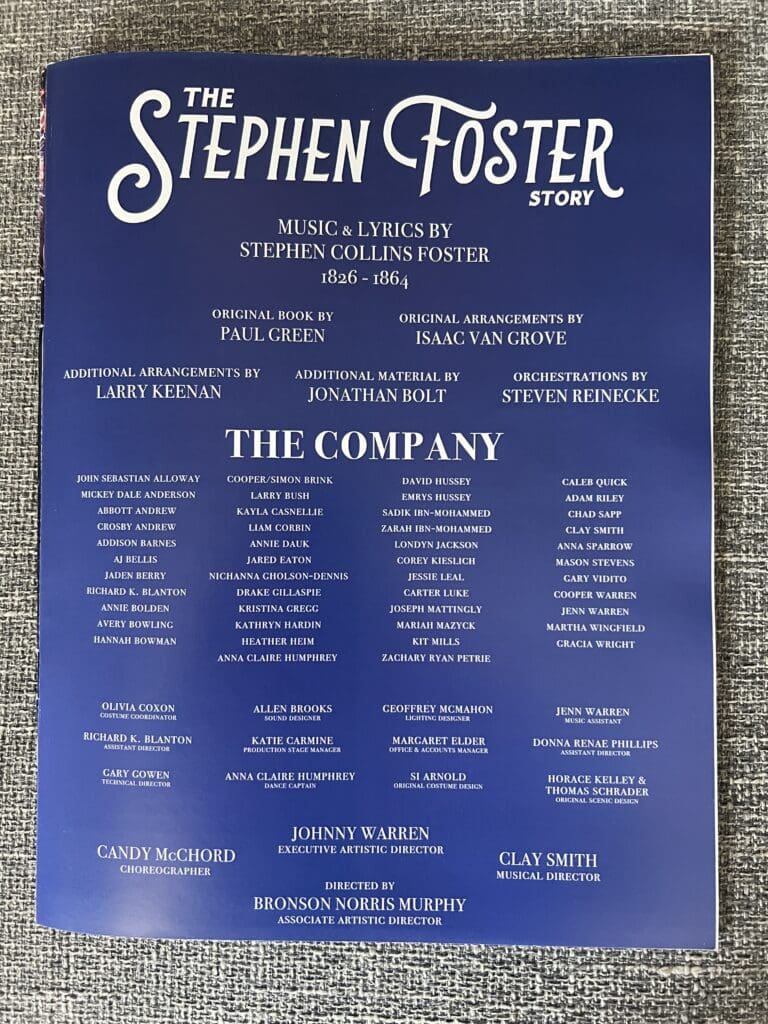
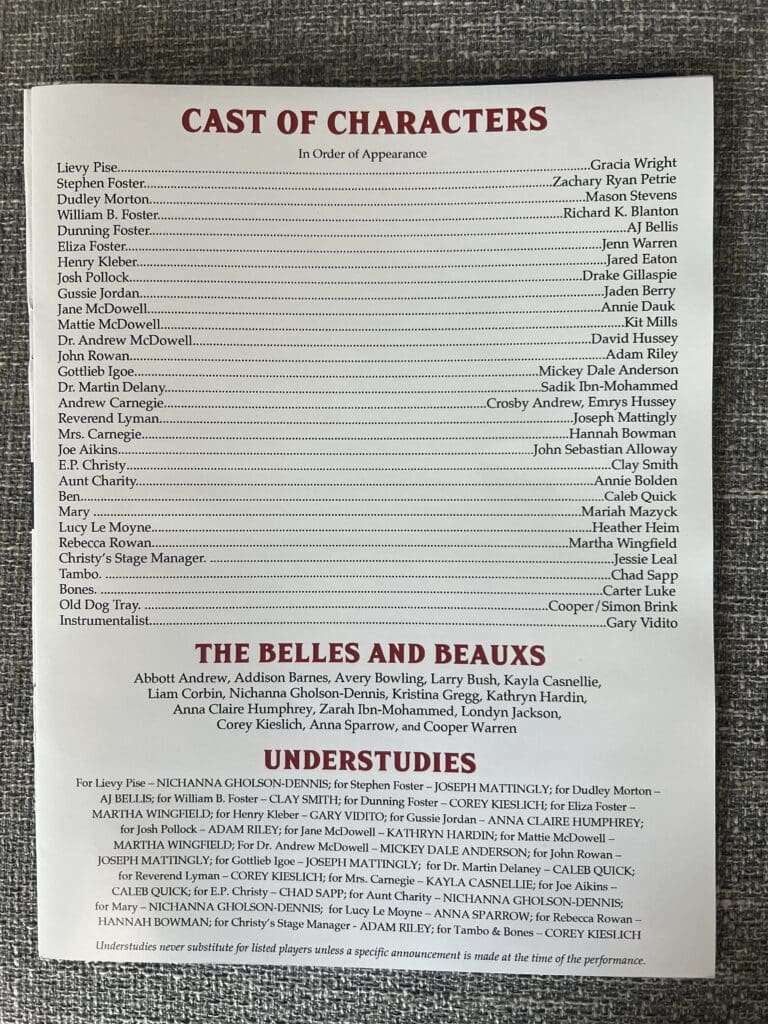
Zachary Ryan Petrie, Stephen Foster, Annie Dauk, and Jane MacDowell convincingly fill their roles with beautiful voices and compelling energy, making them the sympathetic characters the evening requires. The southern socialite Lucy Le Moyne's coloratura passages are the only "operatic" moments in the score, and Heather Heim delivers them beautifully while convincingly playing the overtly flirtatious character. It is always encouraging to hear an audience respond so warmly to classical singing, a reminder that there is still a deep appreciation for the operatic voice. John Sebastian Alloway's baritone voice smoothly rendered the famous "Old Black Joe" with the calm wisdom of his character and is always a high point of the evening.
The changing of The Stephen Foster Story to meet the demands of political correctness
Over the years, the show has adjusted its scene presentation to accommodate the piece's sensitive material. The most glaring difference from my time till now is the "Christy Minstrel Show" scene, where Stephen Foster's famous "Old Folks at Home" provides the high point of the evening. I was impressed by the solutions in several scenes of this summer's production. For all of the political correctness, I do feel like the Minstrel Show scene loses some of its dramatic effect. I don't know how to feel about this issue. But I am not the right person to comment on it, because I don't wear those shoes. I fully support whatever decisions are made because I know everyone's heart is in the right place.
Confrontation with our societal sins
The glaring problem facing the nation during this time in the history of the United States was the issue of slavery. So, the musical does 'go there' and confronts it head-on. Although not yet in full swing, the great American Industrial Revolution is about to get kick-started by a Civil War that we are still dealing with today. Even 'Andrew Carnegie' as a boy is featured in the piece, along with Igoe's industrial business in Pittsburgh or the Honorable John Rowan's selling of Joe, representing the shaky justification, "It was a business decision." The audience is left to deal with their own conscience in reflection of this heavy material.
The question here is, "Why should we revisit these topics?" The answer is "To have a chance to learn from our past societal sins." I was at a conference in Germany where an American presenter was addressing his inner conflict in visiting Germany because of his own Jewish family's history of suffering during the Holocaust of World War II. He said something very profound. "The people here today weren't even alive back then. It isn't your fault. You have been nothing but great towards me during my visit."
No, we weren't alive during the centuries of slavery practiced in America, or the "Trail of Tears" trauma visited upon the Native Americans during, and the abuse of workers during the Industrial Age of America at the beginning of the 20th Century.
Unfortunately, we do inherit history. What we do with that determines our character as a nation. If we forget, we repeat. If we remember, we can build a new history we can be proud of. We are capable of incredible things, but never forget that we are also capable of horrible things. NEVER FORGET.
I love The Stephen Foster Story for the very reason that it confronts us with our history and asks us to live to a higher standard.
Alcoholism, poverty, and self-destruction
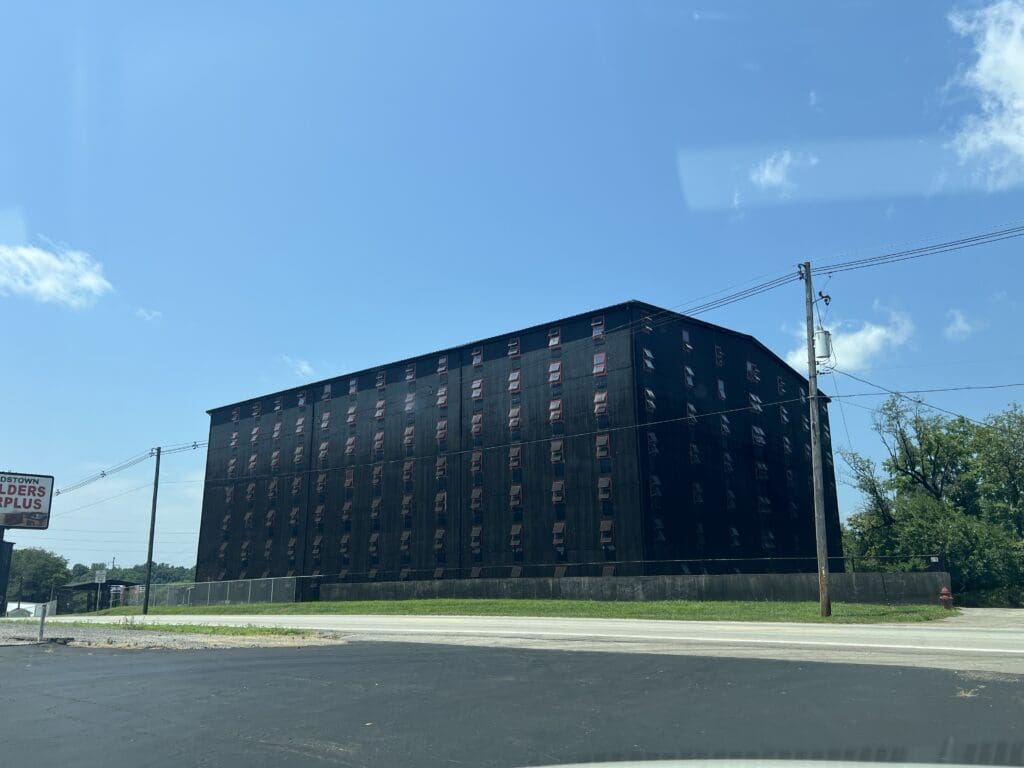
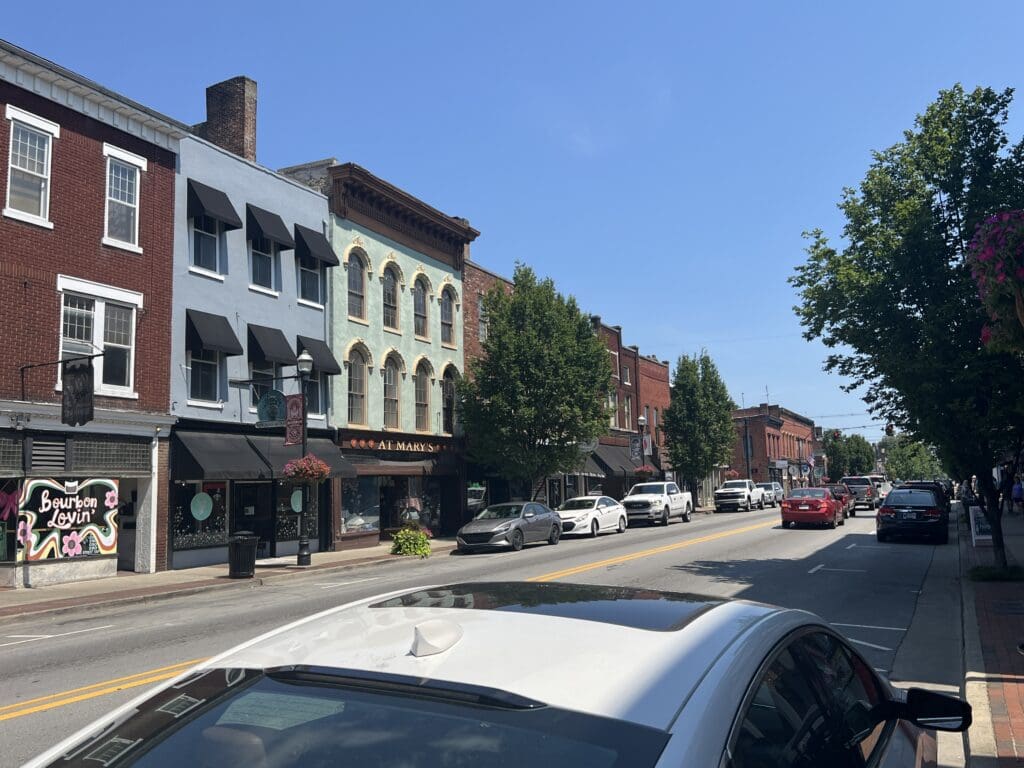
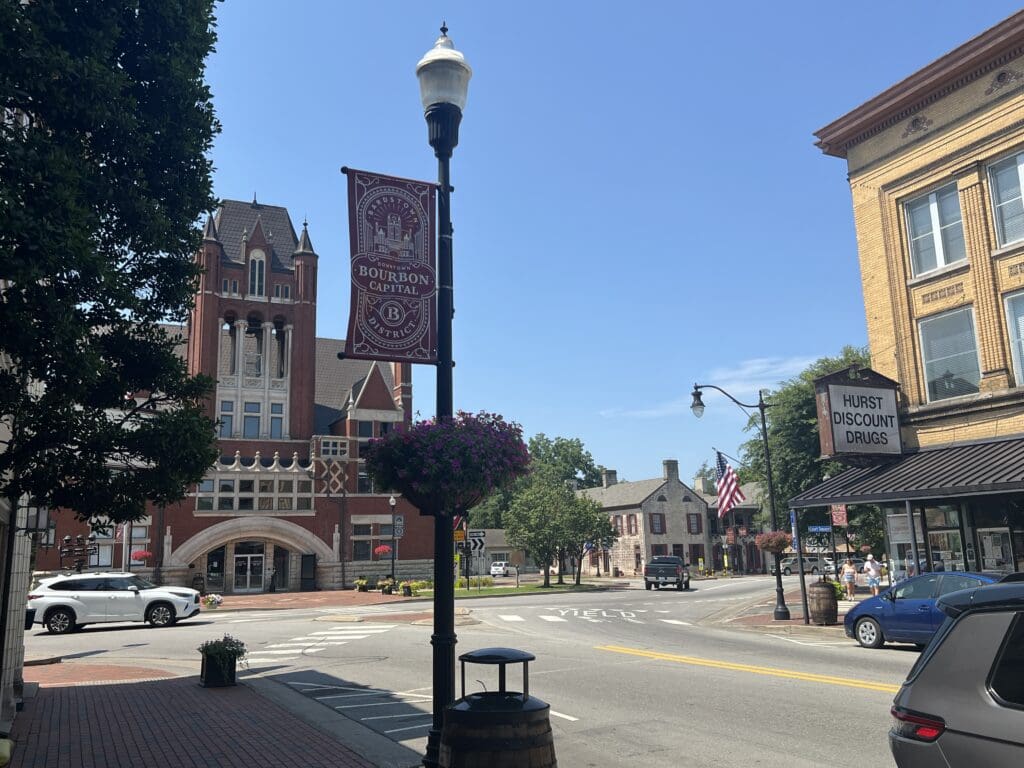
The only 'happy' person in the piece seems to be the drunk "Josh". Everyone loves him because he is so much fun to be around. Even dogs love him the most. Stephen self-medicates with alcohol to temper his enflamed heart. It is quite the irony that this topic comes up in the heart of bourbon country. Either it is all you will ever be, or it is the very thing that destroys you and takes everything you hold dear. In the dream sequence, Stephen relives the moments of his life in a nightmare, which causes him to wake up, realizing that he has to recover or die. In the musical, Stephen gets the girl, and they live 'happily ever after'. The truth about his life is not that, but what did you expect from a musical? "A sad ending?"
An Enduring Cultural Classic and Perennial Favorite
One of the things that makes this evening special is that even if you are going for the 50th time, you still love it. It reminds me of the famous "The Magic Flute" (Die Zauberflöte) by Mozart in the German-speaking countries of Europe. It is like seeing old friends again. You wait for moments during the evening. You love seeing how this Papageno reacts, what sort of Tamino or Pamina will appear. You can't wait for the Queen of the Night to do her spell-bounding acrobatics or Sarastro's deep-voiced ponderings. Here your heart is lifted by Gussie, well performed here by Jaden Berry. The interaction between Stephen and Lievy Pise, passionately presented by Gracia Wright, is just heartwarming. The interlude with "Old Dog Tray" has nothing to do with the story, but the evening wouldn't be complete without it. Drake Gillaspie's Josh is lighthearted and sincere, even if he makes generous use of the bottle. There are many such scenes that, when they come, it is difficult not to be moved by them, and the more you see it, the bigger the effect. Since The Stephen Foster Story is produced solely in Bardstown. I think it should be a national pastime to come and see it. It is worth every minute.
Production Values
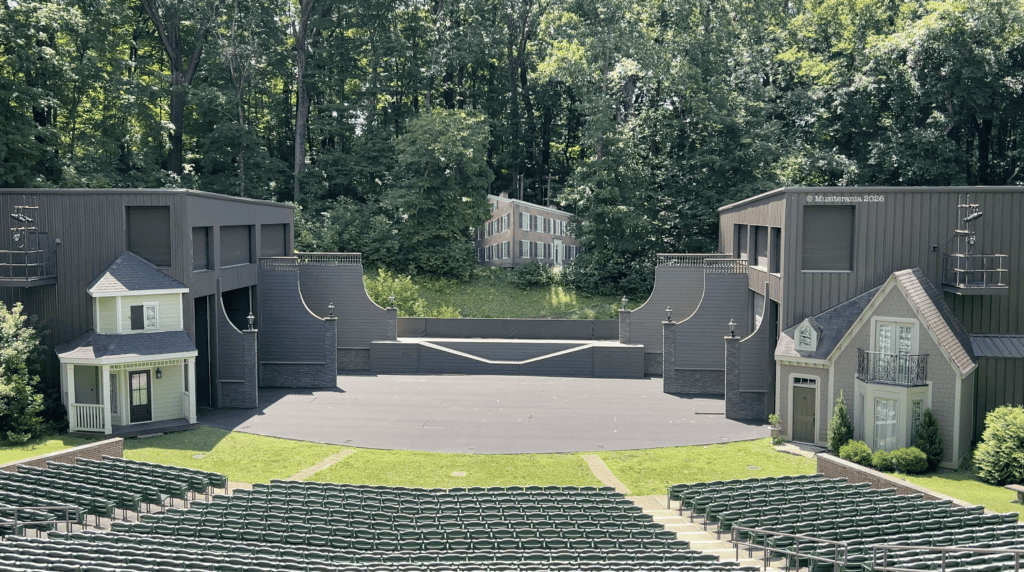
The production of this musical is just really pleasant to the eye. Often with 'Period Pieces' you get the feeling like everything just came out of the attic and the costumes fit poorly or seem somehow dull. I'm allergic to it. Here, the pre-Civil War "Antebellum" style is represented most markedly by the beautiful hooped dresses that the characters wear. I'll never forget Si Arnold at the sewing machine and how her tireless dedication to making everyone look incredible was appreciated by every actor in this piece. Nothing is more important to an actor than having a costume that helps them portray their characters in a way that makes them feel comfortable, beautiful, and powerful. The set was recently rebuilt from the ground up but is essentially the same as it was 45 years ago. Set in the middle of a Kentucky forest, there is a kind of magic that is produced by this intimate atmosphere.
If I have a critique of the evening, it would have to do with the sound system and amplification of the piece. I know how expensive a sound system can be, and it is difficult to maintain such a system when it is exposed to the hot and humid climate of Kentucky in summer. The sound is unbalanced throughout. The main characters have their individual mikes, but those without them are dependent upon the stage mikes to pick up their dialogue and singing. Choral entrances and smaller ensembles fall outside of the soundscape established by the fully supported scenes. I admire their ability to sing with playback orchestral recordings, but I'm not such a fan of it, especially when the speakers don't carry the quality that such music deserves. So, I would encourage a massive upgrade in this area.
Dear Friends and Gentle Hearts
When I consider my colleagues of 45 years ago, my fondness for them grows in my memory. Many from those days have taken the steamboat to paradise. Looking at the program from my year, I am touched by the comments that were written in my book. I didn't keep in touch with any of them after I left, although I crossed paths again with several later in my career, mostly at Eastman. The folly of youth is that you don't know what you have around you because you are so worried about being good enough to justify your own presence in such a wildly accomplished group of singers. I was completely new to the theater, to singing in such a performance, and to being able to do the tambourine line with those incredible dancers. Just yesterday I finally caught up with one of the promo group members only to find out that she had passed just this past March.
It was great to see Gary Vidito again. He is still strummin' the old banjo and guitar as he did so many years ago as well.
The Fourth of July
The fireworks after the show were almost like being 'inside' them. The brilliant blasts of light exploded right in front and above us. It is the best viewing I have ever had of a fireworks show. The show was accompanied by well-chosen music, and the audience reacted enthusiastically to the various sound bites. Without being 'nationalistic,' the evening was a wholesome form of true patriotism, where we can appreciate the moral values our nation claims to believe in, while acknowledging the sins and sacrifices made throughout our past. Let us build a future worth our admiration.
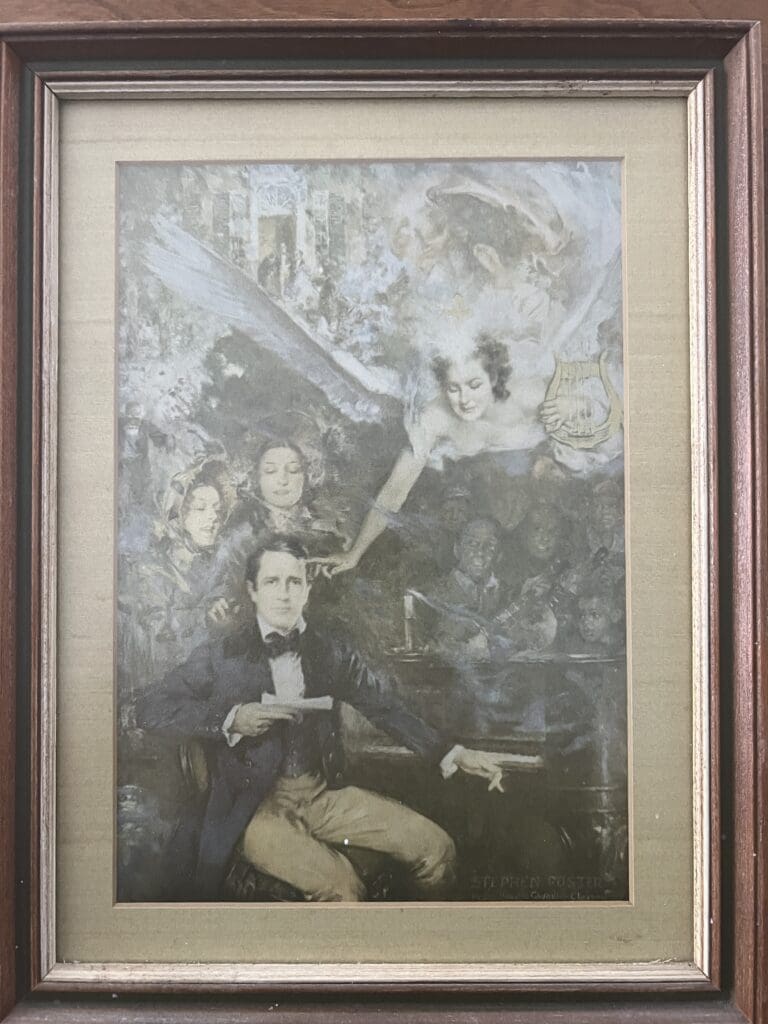
This print has been hanging in our home for decades
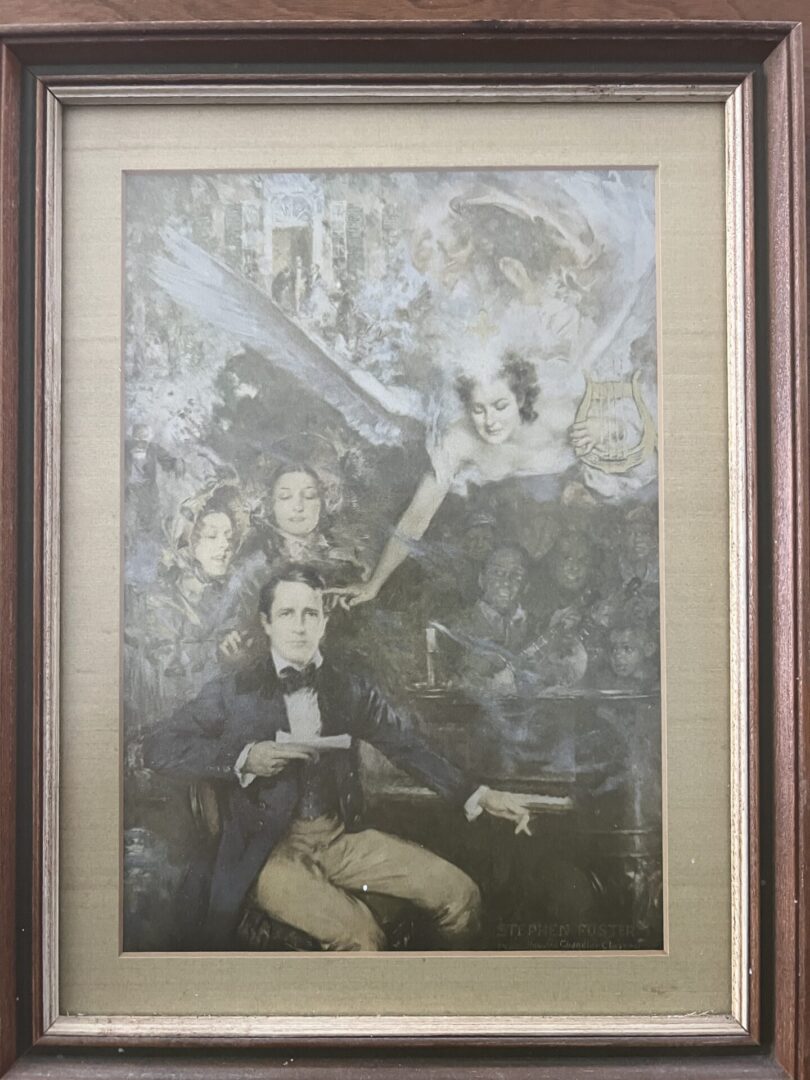
Stephen Foster
By Howard Chandler Christy
Musiterania™
The Stephen Foster Story is more than a summer musical—it is a celebration of Kentucky's musical heritage and a reminder of the hopes, struggles, and dreams that accompany every artist's life. While each generation brings its own style and interpretation, the heart of the production remains unchanged. For those who grew up with it, it is a cherished tradition. For first-time visitors, it offers an opportunity to experience a uniquely American musical story in the very place where it has inspired audiences for generations. Long may the songs continue to be heard from the hills of Bardstown.