
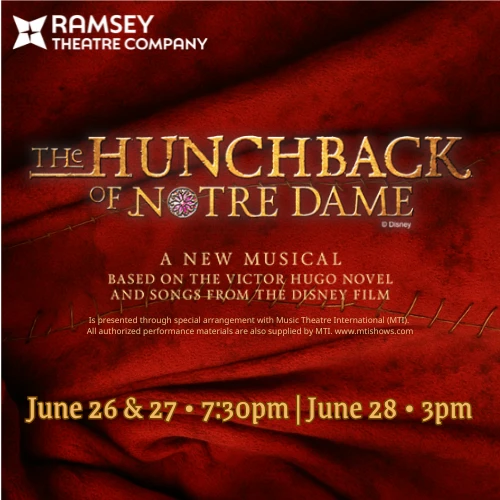
The Hunchback of Notre Dame by the Ramsey Theater Company in Bowling Green, Kentucky
Click on the Link below for the online Program from the production.
https://audienceaccess.co/show/OKY-16381
The Theme of the Evening
The novel by Victor Hugo, "Notre Dame du Paris" or "Our Lady of Notre Dame," was written to create interest in renovating the dilapidated cathedral at the heart of Paris. He made up a story with 'typecast' characters who are general representations of the various classes of post-revolutionary Parisian society of the early Nineteenth Century. You have a Priest, some Gypsies, Soldiers, a King, and a grotesque 'monster' who represents the captive poor souls who do the grunt work of society that nobody sees or wants to see. The moral parallels for today are inescapable, somewhat cliché, but valid, and in those days, very current.
Theatrics
The arts, literature, and the theater are laboratories for the human soul. We create fiction to represent a message. When going to the theater, I try my best to keep this in mind. Because, at the end of the day, it is the meaning that is the very point of it all. The challenge is to interpret that meaning for ourselves, discuss it with others, sift out the elements of truth that confront us, and, by confessing our shortcomings, hope to improve ourselves and our society. The institution of the theater has always been a philosophical playground upon which we can play out various scenarios while falling under the category of "Entertainment". You go for the gag, and return with a deeper understanding of life and yourself. This is why live theater of all kinds is so important for us. We need to examine ourselves and be open to criticism to become better people. Throughout history, theater has been a part of every society and will continue into the future. Why? Because we can and really, we must.
The Challenges of Production
On one hand, the job is to recreate the story so the message comes through. On the other hand, the job is to create a production that demonstrates the highest level of artistry possible with what resources you have at your disposal. No matter who does a production, from grade school to the largest Hollywood films, every production has basically the same challenge: the budget. Regardless of the budget, the job is to create a compelling evening, which usually means to reach people in their souls. As a long-time stage performer, I have done all kinds of productions at all levels. What I have found is that it is easy to get overwhelmed by a great production, but go home with nothing added in your soul. You can also be disappointed with a production for whatever reason, yet come away emotionally touched by something during the evening that makes it worthwhile. There is every variation in between.
Comedy and Tragedy in Musicals, Operas, and all theatrical forms.
In theater, pieces are generally classified either as a comedy or a tragedy. There can be elements of both in each, but generally, the outcome of the story determines whether it is a tragedy or a comedy. But, regardless of which it is, it is all serious theater. Meaning, it takes as much skill to do one as it does the other, and often comedy is even more difficult to execute. For the musical "The Hunchback of Notre Dame," I'd have to classify it as a tragedy because of the deaths that occur at the end. Even though the "monster" survives and becomes a more confident human, it is difficult to feel happy at the end, even when we are happy for him.
The Ramsey Theater Company was ambitious in producing this musical. The bits of mature subject matter represented could make it less appealing to younger audiences. It is a huge show. Bringing everyone together in about a month to put on such a show is daunting. There are many moving parts to such a production, and when promoting yourself as a 'professional' theater company, it raises the bar on expectations. Even so, it is important to recognize that the Ramsey Theater Company and the entire organization are very new, and the population demographics of Bowling Green and the surrounding region are relatively small for such a theater and undertaking. So, it will take time for it to get better and better and better and for the community to actually grasp what it can mean to the region. Creating productions is a tall order at any level; doing Hunchback is not easy.
Mindset of the Audience
For every person that takes a seat in a performance, there is a different mental attitude. We bring our attitude with us, and it colors how we perceive a show. The best way to get the most out of an evening at the theater is to "suspend your disbelief." In other words, accept what you see as being 'just the way it is.' The number one part of the mind that needs to be engaged is the imagination, and to receive the most benefit from a given evening, it is best to allow your imagination to fill in the blanks and not fight what you see and hear with your level of reasoning. Logic has little to do with theater. It is about human nature, what we feel, and gaining a perspective that may challenge our personal views. Actors often have to portray roles that are inconsistent with their own nature. After all, somebody has to play 'the bad guy' for 'the good guy or gal' to be the hero.
Finally: About the Performance:
Producing Artistic Director & Director - Diane DiCroce
Managing Director/Company Manager - Elise Charny
Music Director - Dick Tunney
Assistant Music Director & Rehearsal Pianist - Melissa Bull
Choir Director- Tiffany Harrington
Choreographer - Jake Dukes
Fight Choreographer - Dillon Godolphin
Set Designed and Constructed by Utah Festival Opera and Musical Theatre
Utah Festival Opera and Musical Theatre Technical Director - Kyle Stein
Scenic Design Liaison - Sebastian Tingle
Costumes Provided by - Broadway Costumes, Inc., Chicago, Illinois
St. Aphrodisius Costume Provided by - Tuacahn Costume Rentals
The directors, cast, and crew worked together to build an evening of entertainment that deserves admiration. When you import sets and costumes from other organizations, you have to adapt them to your stage and people. Some things aren't going to fit just right; they may seem a little off-balance, and somehow don't make sense. For example, the long ropes attached to the bells. Ropes on bells don't usually drag the floor. This caused a little bit of a mess onstage, but they managed fine. It was likely designed for a higher proscenium and possibly a deeper stage to give the Rose Window and the Columns in front of the balcony greater depth. It is also possible that the entire balcony with steps could be moved during the show for different scenes, so the dialogue with Quasimodo and the Gargoyles or Storytellers could be more present. Things like this have to be managed, and they did a good job of fitting everything in.
Diane DiCroce, stage director, kept the piece flowing throughout each act. The music is through-composed, so you are forced to move the actors so that they get to their positions in time for the next scene. I found this to be very well managed, and everyone knew what they were doing and did it in character. I found there to be too many downstage center scenes, but this is a matter of taste, not a criticism. Of course, such choices are often made due to the limitations of the circumstances. I'd prefer different positions to be used to reflect the relative intimacy and drama in a scene. I'm still on the fence about having Quasimodo use a character voice in his speech and then use his singing voice for the numbers, but that is also a choice that can be made without being critical of it. I enjoyed the 'Storytellers' as they used the 'stone' faces representing Quasimodo's only companions for his entire life, as well as in the other scenes when they were dressed as other characters.
Dick Tunney, music director, and Orchestra Kentucky contributed something many may not fully appreciate to the show: live music. To have a complete orchestra for a show like this adds to the experience in a big way. Catching the various cues, keeping up with the cast on stage, and helping everyone perform their parts with confidence is a tall job in such a piece that never stops. It is easy to take this for granted, and I had to catch myself not paying attention to the orchestra a couple of times. They played beautifully and had some wonderful moments during the evening. It makes such a difference to have a live ensemble.
Christian Leigh, Quasimodo, didn't shy away from the demands of this tormented character and sang his scenes with full conviction. His fear of Frollo, his shy nature with Esmeralda, and the pain of his shame from the mobbing townspeople were well balanced with his humility and gentle nature. Esmeralda, Astoncia Bhagat, the Gypsy girl whose dances and supernatural talents are used to defend and become a friend to Quasimodo, sings her songs and duets nicely with plenty of warmth and sensitivity, while also projecting a strong image when things get heated. She portrayed the free spirit of a Gypsy while maintaining a higher moral fiber than the self-righteous Frollo. Christopher Hager played the Deacon Frollo of Notre Dame, unashamed of his corrupt character. His baritone voice has a pleasant timbre, and transitions easily from speech to singing, shifting well between the pious Holy Man and the tragically flawed human beneath the robe. Chris Monell played Captain Phoebus de Martin with a sense of duty for his station, but is compelled to side with Quasimodo and Esmeralda when he recognizes the injustice and cruelty. His character is more of a Prince Charming than a heroic warrior returning from the front lines, but it works well within the drama. His pleasant tenor matches nicely with Esmeralda. Max DiSantis portrayed Esmeralda's Gypsy Puppeteer/Showman colleague, presenting a fresh image and clear voice for his important role in the show. His nimble movements were fitting for this witty character.
Bailey Bryant, Florika; Matt Propst, Frederic; Shawn Quinn, Father Dupain; and Gage Carnes, St. Aphrodisius; added to the large cast with accurate characterisations of their roles. The Chorus, Storytellers, and Youth Ensembles filled out the stage with enthusiasm, playing those roles vital to the evening's success. Click Here for the Program.
Reception
The performance was rewarded with enthusiastic applause from the grateful audience. Beyond paying for tickets, donating to the company, or consuming the concessions, the audience is just as important to a performance as anything. Just like the falling tree in the forest makes no sound without someone there to hear it, so is the performance made silent when there is no audience. As much as people may think theater is done for the applause, for the recognition, or even the money, the real purpose is to share a story from the heart to the hearts directly in live performance. There is no post-production editing to be done. It is visceral. It may not always be perfect, but it is always touching.
Reflections
Some things I have been thinking about in reference to the material in this show I'd like to share because whether I am right or wrong about it, it may give you more to think about as well, if you so desire.
What are the 'players' in this piece? Post-revolutionary Paris is the backdrop for this piece. To me, Paris is a lot like London in that it has every class of people in it. From the elegance and wealth of Kings and Queens, to the poverty and suffering of the poor, from the beautiful to the grotesque, from the starving artists and the famous masters, Paris has them all. Victor Hugo is also the author of Les Misérables, which pulls from the same themes. It also reminds me of Charles Dickens' novel "The Tale of Two Cities" or the recently famous "Perfume: The Story of a Murderer" (Das Parfum: Geschichte eines Mörders)by Patrick Süskind. So, the 'feel' of Hunchback is much the same.
The characters of Hunchback aren't real people, but are 'composites' of types of people who populate the society. Quasimodo is the orphan of a murdered mother, whose deformity is probably as much due to the miserable conditions of his birth as anything genetic. His exclusion from society reminds us of those that nobody wants to know exist, doesn't want to see, nor be confronted with. They disturb our 'nice little world'. But they can do the dirty work we need done, like ringing the huge bells in a Gothic cathedral for his entire life. Frollo is the pious 'religious' leader who claims to protect us from infidels who are responsible for our moral decay but is, in reality, also only human and fights it with cruelty. There are the Gypsies, or Roma, who wander the world with their own set of rules. During these times, they were accepted as entertainers and mystics but just for show. They have no rights and were always considered outcasts of society and expendable because they weren't of the faith. It reminds us of the immigrant issues we so elegantly handle these days. The politicians, the King, who conspire with the clergy, Frollo, towards their own ends by supplying the military, Phoebus, to carry out the necessary violence to 'protect' the city, but mostly their authority. The moral authority collapses under their own judgemental nature, and the act of defying orders because it is the right thing to do can be the only moral leadership a nation has to keep from descending into an autocracy. There are the 'people' of the city, otherwise known as the mob. The public can become a mob and be directed to do horrible things to people when they are guided by people of questionable moral character. It is a call to check ourselves as a people and make sure we are actually living the promise of a free society that doesn't do battle in the streets but in the halls of justice and with representative government.
There is plenty to unpack with such subject matter. Whether these conclusions were even meant by the author is not known to me. But, when a story is told, it often has a deeper message than what we originally perceive. I don't claim to be right about anything, but want only to prompt some deeper thinking about this evening that I feel is worth considering.
Musiterania™
Live performance is the very heart and soul of what Musiterania™ is all about. Lifting performances made by aspiring musicians in orchestras and theaters is what it is all about. We want to fill them with enthusiastic audiences by providing previews and reviews of their performances. In today's crazy world of technology, there is a hunger for something real, and nothing is like live performance with real performers in real time to make that possible. Just go!
