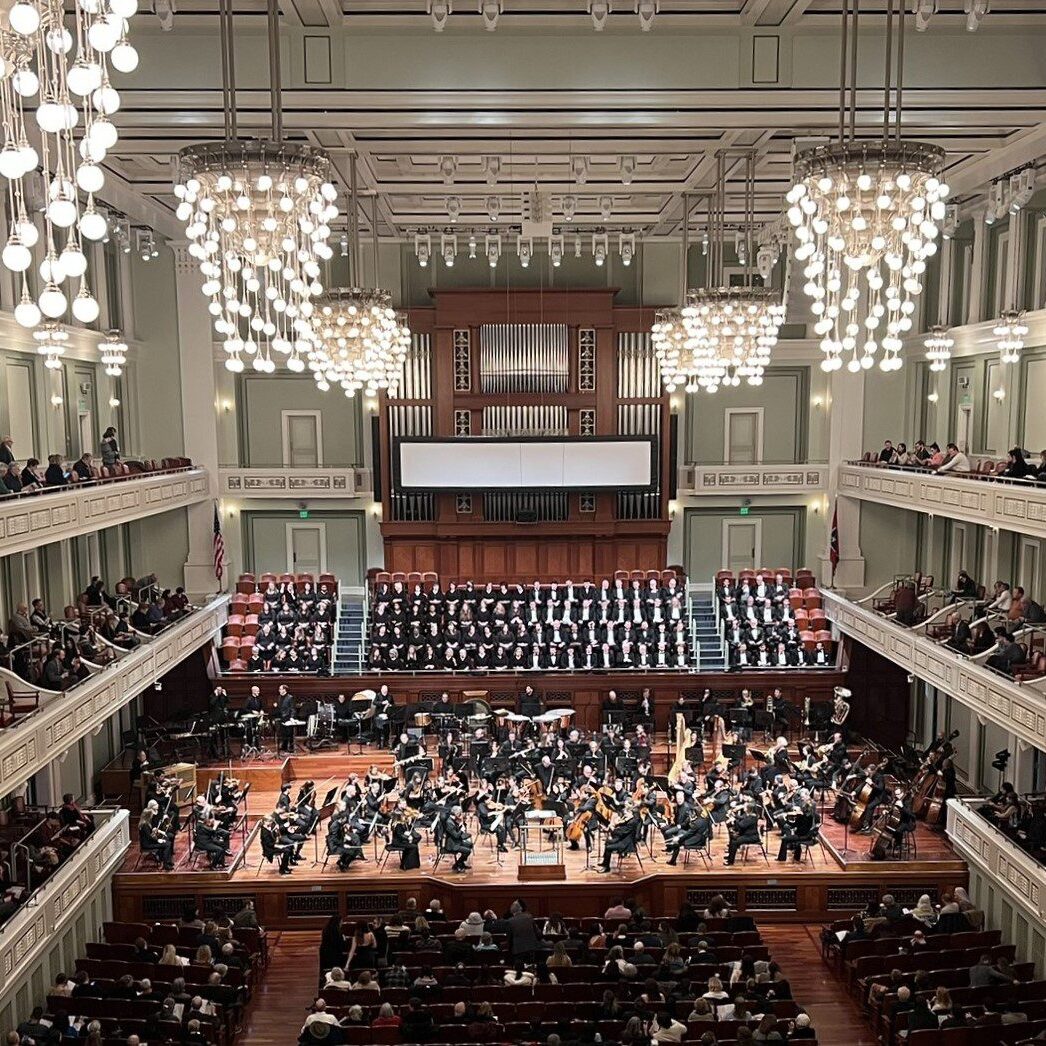
Spano Conducts Bernstein featuring Leshnoff and the Nashville Symphony Chorus
Schermerhorn Symphony Center — Nashville, TN
- Friday, February 6, 2026 — 7:30 PM CST
- Saturday, February 7, 2026 — 7:30 PM CST
Program
Leonard Bernstein: Symphony No. 1 (“Jeremiah”)
Program Notes for “Jeremiah”
INTERMISSION
Jonathan Leshnoff: The Sacrifice of Isaac
Program Notes for “The Sacrifice of Isaac”
Performers
Conductor: Robert Spano
Chorus Director: Tucker Biddlecombe
- Soloists:
- Kelley O’Connor, mezzo-soprano
- Key’mon Murrah, countertenor
- Joshua Lovell, tenor
- Jarrett Ott, baritone
Composing works of this scale for such large forces is an undertaking beyond what mere mortals are usually capable of. Bernstein composed in the old-fashioned way, with paper and pencil. Today, composers can work with computers and immediately hear an approximation of what something might sound like. I don’t know whether Jonathan Leshnoff used the old-fashioned method or modern technology, but regardless, the result is no less stunning. In both pieces, the stage was filled with musicians, featuring ample strings and brass, along with the weight of percussion to round out the forces. It was an impressive sound—possibly the most expansive sound I have heard from the Nashville Symphony.
This concert was being recorded, and when a recording is involved there is an extra level of focus from everyone. I once participated in a recording of the rarely performed Handel opera Adina in a small town on the island of Rügen. The orchestra was a young ensemble from Belarus, and the conductor had rehearsed them only a few times. I didn’t know going in that the performance would be recorded, and when he announced that the recording would be used as a rehearsal playback, I became very nervous. The conductor said, “Recording is the best possible rehearsal.” He was right—everyone was completely locked in. To give some context, we performed in what had once been a horse stall, with a stage built inside the shell of the building. It was a sort of “royal” stall, so the space was quite large. I don’t think I ever took a picture of it. But I digress.
Robert Spano, conductor, led the world premiere of The Sacrifice of Isaac with the Atlanta Symphony in 2024 and was brought to Nashville to make this recording. In both the Bernstein and the Leshnoff, his conducting was very workmanlike—in the best sense of the word. His leadership was marked by the highest level of skill and focus, with no sense of grandstanding. This restraint lent itself to a deeply committed interpretation of the music. It was a joy both to watch and to listen to.
The Bernstein piece was very much in keeping with his temperament: multi-metered, rhythmically offbeat, and a bit corny in that cool, jazzy way. It is fun-loving but still carries the seriousness Bernstein is capable of. His music is idealistic, optimistic, and flamboyant—engaging and enjoyable to listen to. Some passages were gloriously loud in a way that only a full orchestra can achieve. The performance was sensational, particularly because of the massive string forces.
Kelley O’Connor’s mezzo-soprano voice was beautifully projected. The symphony unfolds in three movements: Prophecy, Profanation, and Lamentations. The Lamentations movement sets texts from the Book of Lamentations (1:1–3, 1:8, 4:14–15, and 5:20–21) and is sung in the original Hebrew. Surtitles were provided, which greatly aided understanding. For those interested, more information—including translations and background—is available on Wikipedia. Pieces like this do require some preparation to fully appreciate them, and I highly recommend doing so if you ever have the chance to hear it. It is not performed often enough and should be.
One of the great strengths of Nashville is its abundance of highly skilled session musicians who are accustomed to one-read recording sessions. Strong sight-reading abilities make rehearsals far more efficient and help guarantee a high level of execution in recordings. This professionalism is evident in Nashville’s performances, and the classical music scene is greatly enhanced by it. The ability to augment the orchestra with outside musicians of such a high caliber is something many metropolitan areas simply don’t have.
The Sacrifice of Isaac is a fascinating and very well-composed work. I recommend reviewing the libretto beforehand, as understanding the piece adds greatly to the listening experience. I look forward to the release of the recording and to getting to know the work more deeply.
All of the performances were well done. Countertenor Key’mon Murrah sang with one of the most beautiful countertenor voices I have heard—pure, radiant, and richly colored, carrying effortlessly through the hall. Baritone Nmon Ford’s voice was large and commanding, well suited to the character of the aged Abraham. Tenor Joshua Lovell had a pleasing sound, especially in the middle and lower ranges. The higher tessitura was full and radiant, though at times a bit edgy. The Nashville Symphony Chorus, under the direction of Tucker Biddlecombe, did not always balance against the orchestra at full force, but the sonorous passages were beautiful and some of the effects were gorgeous.
As a performer, I was always pushed hard on diction, and being understood was something I took seriously. I may not have been equally accomplished in every language I sang, but clarity was always at the forefront of my work. Diction is a sensitive topic in classical music, yet I believe being understood is half the performance—and not an easy half. The audience must hear and comprehend the words, grasp their meaning and context, and then absorb how the composer frames that text musically. Achieving clarity can sometimes detract from the perceived “beauty” of the sound, since it often requires breaking the vocal line. Being a tenor does seem to make clarity somewhat easier, at least based on recordings and performances I’ve heard.
Sitting at the back of the hall likely made the text harder to hear, as the sound tends to dissipate into the space. I’m not overly critical on this point, but I may sit closer next time to see if clarity improves. It’s unfortunate when text is lost, as composers invest great care in setting it. At the same time, they also bear responsibility for orchestration that allows vocal lines to be heard.
The evening was thoroughly enjoyable. For anyone wondering whether they should attend a Nashville Symphony concert, my answer is simple: GO. While popular programs have their appeal, the unamplified acoustic concerts are where the full beauty of this glorious music truly comes alive.